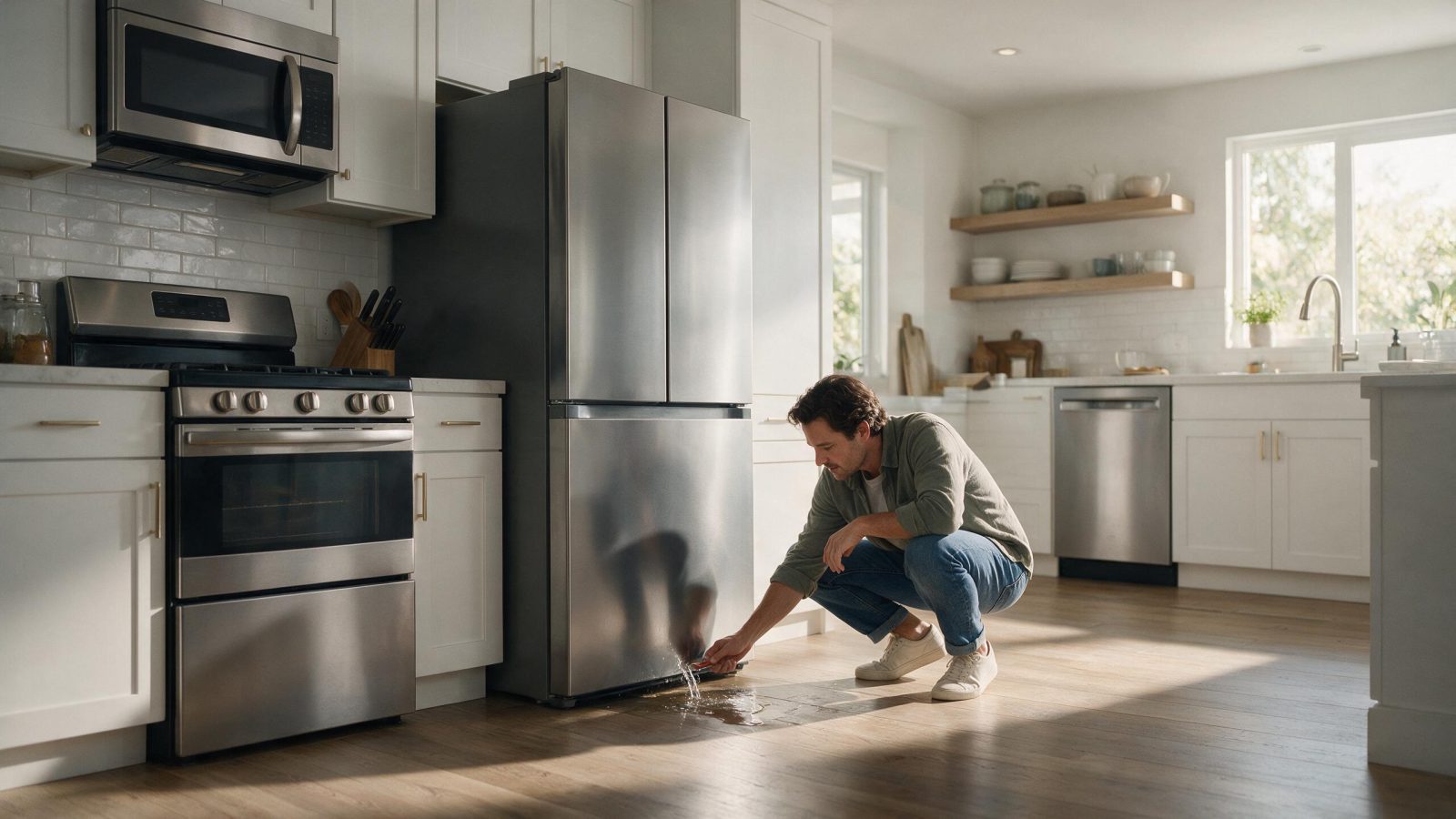
Work out where the water first appears: inside the cabinet, under the unit or at the dispenser. Wipe it dry, check that the door closes and note the spot. If water keeps returning, shut off the water supply to the unit and book a visit.
The model number matters before this symptom is interpreted. GE-family appliances can use different controls and mechanical layouts even when the owner describes the problem with the same words.
Quick answer: Start by documenting the exact symptom, checking the external conditions that do not require disassembly, and recording any display message before power is reset. If the problem persists or the next step requires internal electrical, gas, refrigerant, microwave high-voltage, motor, pump, or control testing, stop and move to professional diagnosis.
The key observation is that water appears under the refrigerator, inside the fresh-food section, or around the dispenser. That narrows the diagnostic tree, but it does not identify a failed component on its own. Note what the appliance was doing immediately before the failure, whether it happens every cycle, and whether another function still works normally. Those details often separate a supply or installation problem from a component-level fault.
This cause can reproduce the same visible symptom on a refrigerator without proving that the first associated part is bad. The useful next step is to check the surrounding system, connections, operating conditions, and model-specific behavior before replacement.
This cause can reproduce the same visible symptom on a refrigerator without proving that the first associated part is bad. The useful next step is to check the surrounding system, connections, operating conditions, and model-specific behavior before replacement.
This cause can reproduce the same visible symptom on a refrigerator without proving that the first associated part is bad. The useful next step is to check the surrounding system, connections, operating conditions, and model-specific behavior before replacement.
This cause can reproduce the same visible symptom on a refrigerator without proving that the first associated part is bad. The useful next step is to check the surrounding system, connections, operating conditions, and model-specific behavior before replacement.
This cause can reproduce the same visible symptom on a refrigerator without proving that the first associated part is bad. The useful next step is to check the surrounding system, connections, operating conditions, and model-specific behavior before replacement.
This cause can reproduce the same visible symptom on a refrigerator without proving that the first associated part is bad. The useful next step is to check the surrounding system, connections, operating conditions, and model-specific behavior before replacement.
Do not continue if you encounter smoke, a burning odor, visible arcing, unburned gas odor, significant water around live electrical parts, severe overheating, or damaged wiring. Sealed-system, compressor, refrigerant, energized defrost, and control-board diagnosis should be left to qualified repair personnel.
The preserved GE model library includes multiple GE, GE Profile, Café, and Hotpoint platforms in this appliance category. A model prefix may suggest a family, but the full rating-label model is the safer key for service documentation and parts decisions. Do not borrow a code meaning, test sequence, or part from a similar model simply because the cabinet looks the same.
Once safe external checks are exhausted, a technician can choose tests that match the symptom rather than replacing parts by probability alone. Depending on the model, that may include:
The final repair recommendation should explain what evidence was found and why it fits the exact appliance behavior.
If the appliance displays a code, record it exactly as shown and use the GE error-code library with the appliance and family context intact. A recurring code can be valuable evidence, but it still needs to be reconciled with the symptom and model. If no code appears, continue with symptom-based diagnosis rather than assuming the control system has ruled out a failure.
Request service when the appliance cannot perform its main function, the symptom returns after safe external checks, a leak or overheating condition is present, a recurring code returns, or the next diagnostic step requires internal testing. For an intermittent failure, a short video and a note about where in the cycle it happens can be especially useful.
Request GE Refrigerator Repair →
Maintenance helps with conditions such as residue, airflow restriction, loading, door sealing, or drainage, but it cannot prevent every sensor, motor, pump, heater, compressor, valve, or control failure.
Copy the complete model number, save any code, describe when the symptom occurs, and make ordinary access to the appliance clear. Do not dismantle the appliance in preparation for service. Provide the Los Angeles or Orange County service address so routing and availability can be confirmed.
A reset can clear a temporary control state, but record any code first. If the same symptom or code returns, the underlying condition still needs diagnosis.
Usually no. Common symptoms overlap across several systems, and the correct component can depend on the exact model and revision.
That depends on the symptom. Stop use for smoke, burning odor, arcing, gas odor, major leaking near electrical components, severe overheating, or any condition that appears unsafe.
Use the GE Refrigerators reference for model, system, maintenance, and error-code context.
For GE refrigerator leaking water, preserve the evidence, perform only safe external checks, and let the exact model guide the next diagnostic step. The goal is not to guess the most popular failed part; it is to identify the system that actually explains the symptom.
Check the door first, since a GE microwave that will not start or stops mid-cycle may not be closing fully, or the latch area…
Start with the grease filters and the outside duct outlet, because a clogged filter or a stuck flap can weaken a GE range hood…
Redistribute the load first, because an unbalanced or oversized load can keep a GE washer from spinning. Make sure the lid or door is…
Share a few details and we’ll confirm an appointment. Prefer to talk? Call us and we’ll help right away.
Fields marked with * are required.